
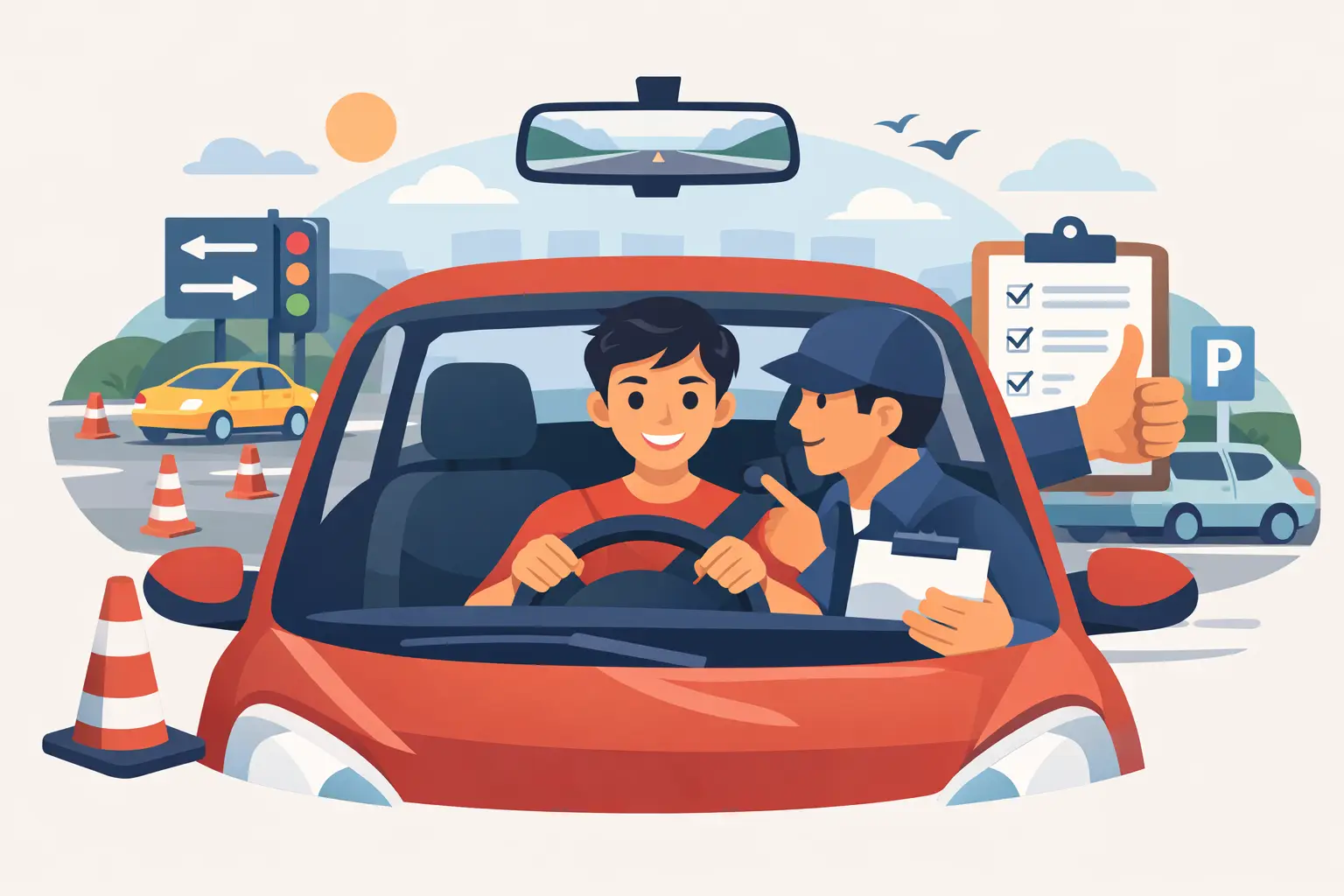
The practical driving test is not about producing a perfect, silent drive. It is about showing that you can make safe decisions, stay aware of what is around you and deal calmly with ordinary road situations. If you are wondering how to pass driving test day without letting nerves take over, focus less on trying to impress the examiner and more on driving as you have been taught.
A good test result usually comes from steady preparation over several lessons, rather than a last-minute rush around likely test routes. You need the right skills, but you also need a routine that makes those skills reliable when someone is watching.
Build safe habits, not test-day tricks
The examiner is looking for a safe, controlled and independent driver. That means your observations, positioning, speed and judgement should work together throughout the drive. A hesitation at a difficult roundabout is not automatically a problem if you are waiting for a safe gap. Pulling out when it is not safe, however, can become a serious fault.
This is why the best preparation is repeated practice in real conditions. Drive on quieter residential roads, busy roundabouts, dual carriageways where appropriate, hill starts, awkward junctions and unfamiliar areas. Milton Keynes has plenty of roundabouts, varied speed limits and busy routes, so learners benefit from practising how to read the road rather than memorising one route.
During lessons, ask your instructor to explain why a decision is safe or unsafe. Understanding the reason behind a mirror check or a road position makes it much easier to repeat naturally under pressure.
Make your observations clear and useful
Many learners know they should check mirrors, but on test day they either rush the check or perform it without using the information. Effective observations are not a performance. They help you spot cyclists, pedestrians, motorbikes and traffic that may affect your next move.
Use your mirrors before changing speed or direction. For example, check before signalling, moving off, turning, changing lanes, pulling up or slowing for a hazard. Check blind spots when moving away from the kerb and whenever your vehicle could cross another road user’s path.
Do not fixate on mirrors so much that you stop looking ahead. Your main view should always be the road in front, with timely checks around you. A calm, regular routine is more convincing and safer than exaggerated head movements.
Plan further ahead
Forward planning gives you time to respond smoothly. Look beyond the car directly in front and notice road signs early. If a speed limit changes, adjust promptly and safely. If traffic is building near a crossing or roundabout, ease off the accelerator early rather than braking sharply at the last moment.
This approach also reduces nerves. When you have a plan, junctions and busy roads feel less like surprises. You are simply dealing with one safe decision at a time.
Practise the parts of the test that create pressure
Most people have a few areas that make them tense. It may be parallel parking, meeting traffic on a narrow road, driving independently or joining a faster road. Avoiding those situations can make the anxiety grow. Instead, tell your instructor exactly what feels difficult and practise it until the process becomes familiar.
You may be asked to complete one manoeuvre, such as bay parking, parallel parking or pulling up on the right and reversing. The exact task matters less than your control and observations. Drive slowly enough to think, steer accurately and be prepared to correct your position if needed. A small adjustment is often better than continuing with a poor position.
You should also be comfortable with pulling up safely at the side of the road, moving off again and completing a hill start where required. Before stopping, choose a safe and legal place. Avoid stopping near junctions, crossings, bends, bus stops or where road markings prohibit it.
The independent driving section can feel daunting because you may follow a sat nav or traffic signs. You are not being tested on your sense of direction. If you take a wrong turn but continue safely, that is normally not a reason to fail. Follow the road safely, listen to instructions and do not make a sudden lane change or turn to correct a missed direction.
Know the show me, tell me questions
These questions are straightforward when you have practised them in the car you will use for the test. One question is asked before driving, and another while driving when it is safe to do so. The aim is to show basic knowledge of vehicle safety, such as checking tyres, lights, brake lights, oil or screenwash.
Do not learn answers as a script without understanding them. Your instructor can show you where the controls are and help you practise explaining checks in plain language. If you make a mistake on a vehicle safety question, stay composed. It is not the same as making a serious driving error, and you still have the rest of the test to show safe driving.
Take mock tests seriously
A mock test is one of the most useful ways to prepare because it reveals what changes when you feel observed. Ask your instructor to run it as realistically as possible, with minimal prompts and a mixture of familiar and unfamiliar roads. Afterwards, review the drive honestly.
Look for patterns rather than judging yourself over one mistake. Perhaps you rush approach speeds at roundabouts, forget a final mirror check before pulling up, or let a missed instruction distract you. These are practical issues that can be improved with focused lessons.
You do not need to be completely fault-free in every mock test before booking. You do need to show that you can drive safely and consistently, recover from minor errors and make sensible decisions without relying on constant help.
Prepare for test day the evening before
Being organised removes avoidable stress. Make sure you have the correct provisional licence and that your test details are confirmed. If you are using your instructor’s car, agree where and when you will meet. At Pav’s Driving School, test preparation can include a lesson before the appointment and car hire for the driving test, helping learners arrive settled and familiar with the vehicle.
Get enough sleep, eat something light and give yourself time to arrive without rushing. Wear comfortable footwear that gives you good control of the pedals. New, heavy boots or loose sandals can make clutch control and braking feel different.
Before setting off, take a few moments to set your seat, mirrors and steering position. You should reach the pedals comfortably, see clearly and feel secure. This familiar routine is a useful signal to your mind that you are ready to drive.
What to do when nerves appear
Nerves are normal, including for learners who drive well in lessons. Trying to eliminate them completely is rarely helpful. The goal is to prevent them from controlling your decisions.
Use a simple breathing routine while you wait: breathe in steadily, then breathe out a little more slowly. Keep your attention on practical actions, such as checking your mirrors, finding the biting point and reading the next sign. Avoid analysing every word the examiner says or guessing whether you have passed halfway through.
If you stall, take a breath, secure the car and restart when safe. Stalling alone does not mean you have failed. What matters is how you respond and whether you remain aware of other road users. The same applies if you mishear an instruction or select the wrong gear. Correct it safely and continue.
Understand faults without driving scared
Learners sometimes become so afraid of making a fault that they drive too cautiously. Excessive hesitation, very slow progress or refusing safe opportunities can create problems of their own. Aim to be safe, but also make reasonable progress when the road allows it.
Minor driving faults can happen. They may include a late mirror check where no one is affected, a slightly imperfect position or a moment of hesitation. Serious or dangerous faults involve a higher level of risk, poor judgement or a situation where another road user is affected or could be affected.
You cannot control every traffic situation. You can control your response: observe, plan, choose a safe speed and give yourself time. That is exactly what a competent driver does after the test as well.
The final lesson is for confidence, not cramming
Use your final lesson to settle into the car and refresh your routine, rather than attempting to learn a completely new technique. If there is one area that needs attention, practise it calmly. Then spend time driving normally, making decisions independently and reminding yourself what you already do well.
Passing your test is a valuable milestone, but the real achievement is becoming the kind of driver who stays safe when the roads are busy, unfamiliar or unpredictable. Take the test one road, one observation and one sensible decision at a time.