If your practical test is coming up, one of the most common questions is how long is the DVSA driving test. It matters because knowing the timing helps you prepare properly, settle your nerves, and avoid surprises on the day. Most learners are relieved to hear that the test itself is not especially long, but every minute counts, so it helps to know exactly what happens and when.
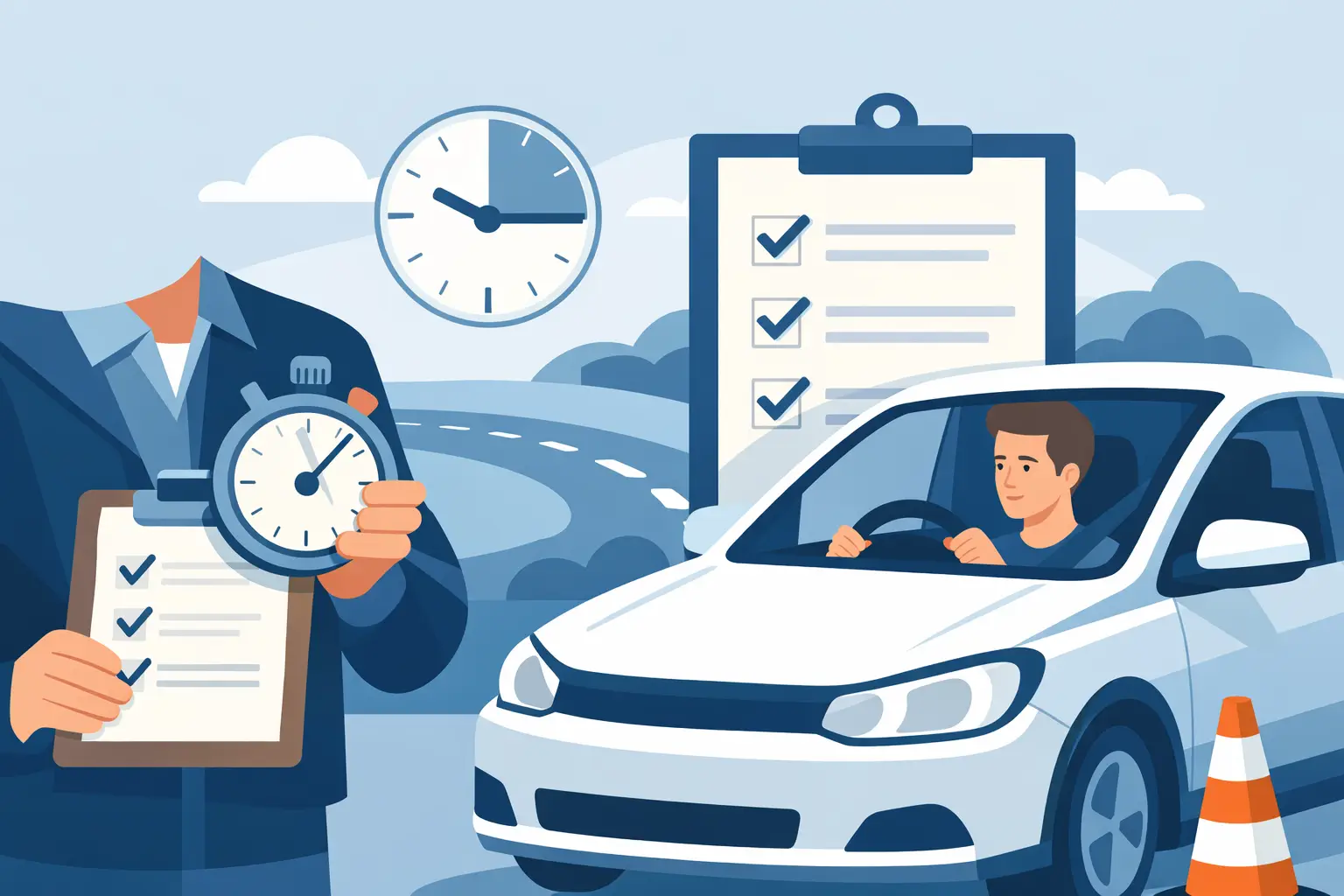
The standard DVSA practical driving test lasts around 40 minutes. If you are taking an extended driving test after a driving disqualification, it usually lasts about 70 minutes. For most learners in Milton Keynes and nearby areas, the standard 40-minute test is the one that applies.
That headline figure is useful, but it does not tell the full story. Your appointment slot may feel longer than 40 minutes because there is some preparation before the driving begins and a short debrief afterwards. If you are hiring your instructor’s car for the test, or having a lesson before it, you will usually be with your instructor for longer than the official test time.
How long is the DVSA driving test from start to finish?
The official driving part of the DVSA practical test is around 40 minutes. During that time, the examiner checks that you can drive safely and independently in a range of road and traffic conditions. If you are taking the extended test, expect around 70 minutes of driving instead.
In practice, the full appointment often feels closer to 45 to 50 minutes once the examiner meets you, checks your licence, and explains the format. There is then a short period at the end when the examiner tells you the result and talks through any faults recorded.
That means there are really two answers to the question. If you are asking about the official test drive, it is around 40 minutes. If you mean the whole experience at the test centre, allow a bit longer.
What happens during the 40-minute DVSA driving test?
The practical test is structured, which is good news if you are someone who feels calmer when you know the plan. It begins before you even move off.
First, the examiner will ask you to read a number plate from the required distance. This is the eyesight check, and you must pass it to continue. You will also be asked one vehicle safety question. These are the familiar show me, tell me questions you practise with your instructor.
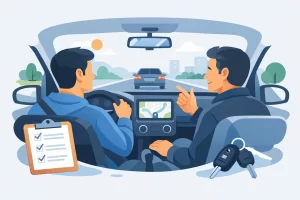
Once the driving starts, you will spend most of the test on normal roads. The examiner will ask you to follow directions, and for roughly 20 minutes of the test you will be driving independently. That might mean following sat nav instructions or following road signs. This part catches some learners out, not because it is harder, but because they worry too much about taking a wrong turn. In reality, taking the wrong route is not a fault unless you do it unsafely.
At some point, you will usually be asked to carry out one reversing manoeuvre. This could be parallel parking, bay parking, or pulling up on the right and reversing for about two car lengths. You may also be asked to do an emergency stop, although that does not happen on every test.
The routes vary, and traffic conditions can affect the flow of the test. A 40-minute drive through busy town roads feels different from 40 minutes on quieter roads, but the timing stays broadly the same.
Why the test length matters
Knowing how long the DVSA driving test is helps in a very practical way. Many learners build the test up in their mind as a huge event, when actually it is a short, focused drive where you show the safe habits you have already been practising.
Forty minutes is long enough for the examiner to see how you handle different situations, but short enough that you do not need to be perfect for a long stretch. One minor fault does not mean you have failed. A small hesitation at a roundabout or a slightly untidy gear change can still lead to a pass if your driving is safe overall.
That is why good preparation matters more than trying to impress. Calm, consistent driving is what the examiner wants to see.
What can make the test feel longer or shorter?
Even though the official timing is fixed, your experience of it can vary. Nerves can make ten minutes feel like half an hour, especially at the start. Once you settle in, many learners are surprised by how quickly the test goes.
Traffic also plays a part. If the roads are busy, there may be more stopping and waiting at junctions, traffic lights, and roundabouts. That does not mean the examiner is judging you more harshly. In fact, dealing safely with everyday traffic is part of what the test is designed to assess.
Weather can have an effect too. Heavy rain or poor visibility can make the drive feel more intense, but again, the examiner is looking for safe decision-making rather than flawless driving. Sometimes a cautious approach is exactly the right one.
How long should you allow on test day?
If your appointment is at a set time, avoid planning your day around only 40 minutes. Give yourself extra time before and after. If possible, arrive with enough time to settle yourself rather than rushing in flustered.
Many learners benefit from a lesson beforehand. That gives you time to warm up, practise a few key areas, and get into the right frame of mind. If you are using your instructor’s car, your total time commitment may be a couple of hours once pre-test practice, travel, and the test itself are included.
For local learners, especially around Milton Keynes, that extra preparation can be useful because it helps you adjust to the roads, roundabouts, and general pace of driving before the examiner joins you.
How long is the DVSA driving test if you need special arrangements?
Some learners have special requirements, and in those cases the overall process can differ slightly. If you have hearing difficulties, certain physical needs, or another condition that requires reasonable adjustments, the test may involve adapted communication or arrangements.
The core driving assessment still follows the DVSA standard, but practical details can take a little longer. What matters most is making sure everything is declared properly in advance so the test can run smoothly on the day.
If English is not your first language, or if anxiety is a concern, it is still worth remembering that the structure of the test remains straightforward. Clear preparation often reduces worry far more effectively than last-minute cramming.
Common worries about test timing
A lot of learners ask whether the examiner can end the test early if they think you have failed. In the standard practical test, the examiner usually continues unless there is a safety reason not to. So even if you think you have made a serious mistake, stay focused and keep driving safely. People often assume they have failed when they have not.
Another common question is whether the test can run over time. Small variations are possible depending on traffic and route, but the examiner is working to a planned format. You do not need to worry about being out for a much longer drive than expected.
Some learners also wonder whether a shorter-feeling test means they have done badly. Not necessarily. The route can simply feel quick when you are concentrating hard. Try not to read too much into timing while the test is happening.
How to prepare for a 40-minute practical test
The best preparation is not trying to cram in every possible scenario. It is building the stamina and focus to drive safely for 40 minutes without your instructor prompting you through every decision.
That means practising independent driving, not just the technical skills. You need to be comfortable reading signs, following a sat nav, choosing the correct lane, and recovering calmly if something does not go to plan. Real driving is not about never making a mistake. It is about dealing with the road safely when things change.
It also helps to practise full mock tests. A proper mock gives you a feel for the length and pressure of the real thing. You learn that 40 minutes is manageable, and that keeping your concentration matters more than chasing perfection. At Pav’s Driving School, that kind of calm, one-to-one preparation is often what helps learners feel ready rather than rushed.
On the day itself, eat something light, bring your provisional licence, and wear comfortable shoes. Arrive in good time. Then focus only on the next moment – the next junction, the next mirror check, the next decision. That approach makes the test feel smaller and more manageable.
The DVSA driving test is long enough to show whether you are a safe driver, but short enough that solid preparation and a calm mindset can carry you through. If you know what to expect, 40 minutes can feel a lot more achievable than you think.