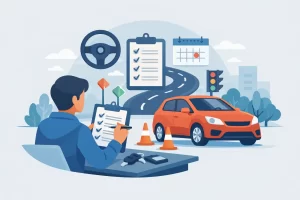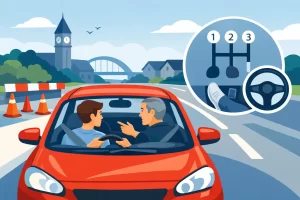
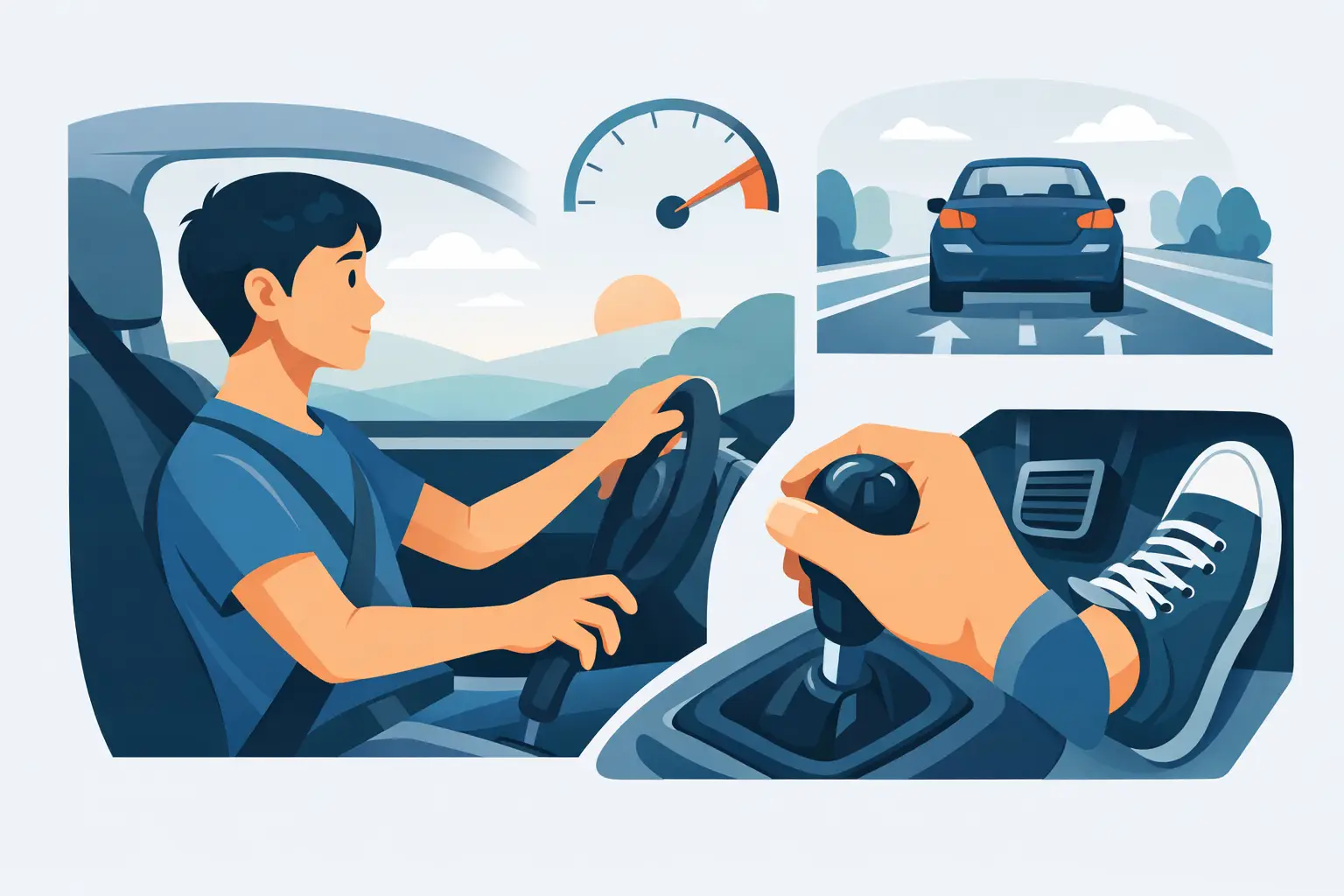
The first time you sit in a manual car, there can seem to be a lot happening at once: three pedals, a gear lever, mirrors, signals and other road users to consider. Learning how to drive a manual car becomes much more manageable when you build each skill in the right order. Start slowly, practise somewhere suitable and give yourself time to feel the clutch rather than trying to get everything perfect straight away.
Before you drive a manual car
Before moving off, set yourself up properly. Adjust the seat so you can press the clutch pedal fully to the floor without stretching, while still keeping a slight bend in your left knee. Set the steering wheel, head restraint and mirrors, then fasten your seat belt.
In a manual car, your left foot works the clutch. Your right foot operates the accelerator and foot brake. Avoid resting your left foot on the clutch while driving, as this can reduce your control and cause unnecessary wear.
If you are practising outside a lesson, make sure you have a valid provisional licence, L plates and suitable insurance. Your supervising driver must be at least 21 and have held the relevant full driving licence for at least three years. For a complete beginner, learning with a qualified instructor in a dual-control car provides a calmer and safer starting point.
Get to know the pedals and gears
The pedals are arranged from left to right: clutch, brake and accelerator. The clutch temporarily disconnects the engine from the wheels, allowing you to select a gear or come to a stop without stalling. It is the part that takes the most practice, but it soon becomes familiar.
With the engine switched off and the parking brake applied, look at the gear pattern on top of the gear lever. First gear is used to move away slowly. Second and third gears are commonly used at lower speeds, while higher gears are for faster roads when conditions allow. Reverse is positioned differently depending on the car, so always check before you need it.
Press the clutch fully down before selecting a gear. When you release it, do so smoothly and gradually. The point where the clutch begins to connect with the engine is often called the biting point. You may notice the engine note change slightly or feel the front of the car lift a little. This is normal.
Start the engine safely
Check that the parking brake is on and the gear lever is in neutral. Neutral allows the gear lever to move side to side freely. Press the clutch down fully, start the engine and keep the clutch held down while you select first gear.
Before moving, use the correct observations. Check your mirrors, look over the appropriate shoulder for cyclists or pedestrians, and assess whether it is safe to go. Good driving is not just about controlling the car. It is about making safe decisions before the car moves.
How to move off without stalling
Moving off is where many new learners worry about stalling. A stall is simply the engine stopping because the clutch has come up too quickly or there is not enough accelerator. It is common, particularly in the first few lessons, and it is not a failure.
To move away on level ground, select first gear with the clutch fully down. Apply a small amount of accelerator, usually enough to raise the engine sound gently. Then lift the clutch slowly until you find the biting point. Release the parking brake, continue to bring the clutch up smoothly and add a little more accelerator as the car begins to roll.
Once the car is moving, remove your left foot completely from the clutch and place it on the footrest. Look well ahead, keep both hands on the steering wheel where practical and build speed gradually.
If the car stalls, stay calm. Secure the car with the foot brake and parking brake if needed, select neutral, restart the engine and prepare again. An instructor will help you understand whether you released the clutch too quickly, used too little accelerator or tried to move away in the wrong gear.
Changing gears smoothly
You usually change up as the car gains speed and the engine begins to sound busier. There is no single speed that suits every road and every car, so learn to listen to the engine as well as checking your speed.
To change from first to second gear, ease off the accelerator, press the clutch fully down and move the gear lever gently into second. Bring the clutch up smoothly, then return to the accelerator. Do not force the gear lever. If it does not move easily, check that the clutch is fully pressed down.
When slowing down, brake first where appropriate, then select a lower gear when the speed is right for it. This gives you better control, especially before a bend, junction or roundabout. Avoid coasting – travelling with the clutch held down or the car in neutral – because it reduces your control of the vehicle.
Stopping the car
To stop in normal traffic, check your mirrors, ease off the accelerator and brake progressively. When the car is nearly stationary, press the clutch down to prevent stalling. Stop in a safe position, select neutral and apply the parking brake if you will be waiting.
This sequence takes practice. At first, focus on being smooth rather than trying to react quickly. Smooth braking gives drivers behind you clearer information and makes the car more comfortable for everyone inside.
Hill starts in a manual car
Hill starts require more clutch control because the car can roll backwards. The parking brake is there to help you, so use it rather than rushing.
With first gear selected, find the biting point and apply a little accelerator. When you feel the car is ready to move forwards, release the parking brake while keeping your feet steady. As the car moves, gradually lift the clutch fully and add enough accelerator to continue up the hill.
The exact amount of accelerator depends on the steepness of the hill, the car and whether you are carrying passengers. Practise hill starts in a quiet location before tackling busy uphill junctions. If you stall, keep the car secure and start the process again rather than panicking.
Build confidence at junctions and roundabouts
Manual control matters most when you have to combine it with planning. As you approach a junction, look well ahead and give yourself time. Check mirrors, signal if necessary, reduce speed and select the gear that will suit what you need to do.
If you may have to stop, first gear is normally needed to move away again. If the road is clear and you can continue moving slowly, second gear may be more suitable. Your instructor will help you judge this based on the road layout, traffic and your speed.
At roundabouts, avoid focusing only on the gear lever. Your priority is observation, position, speed and choosing a safe gap. The gear change should support those decisions, not distract from them.
Practise the right way
Short, focused practice sessions are often more useful than driving for hours when you are tired. Begin with moving off and stopping on a quiet road, then add left and right turns, gear changes, meeting traffic and hill starts. Build up to busier routes only when the earlier skills feel controlled.
It helps to talk through what you are doing. For example: mirrors, signal, position, speed, gear, look. Saying the routine aloud can make it easier to remember until it becomes natural.
At Pav’s Driving School, one-to-one manual lessons are structured around your current ability, whether you are starting from scratch, returning after a break or preparing for your practical test. A calm instructor can spot small habits early, such as looking down at the gear lever or releasing the clutch too sharply, before they become harder to change.
Common manual driving mistakes to avoid
New drivers often watch the gear lever while changing gear. Keep your eyes on the road instead and learn the gear pattern by feel. It is also common to brake too late, which leaves little time to select the correct gear and assess the road ahead.
Another frequent mistake is holding the car on a hill using the clutch and accelerator. This can wear the clutch and makes rolling back more likely. Use the parking brake until you are ready to move.
Most importantly, do not let one stall affect the rest of the drive. Safe drivers recover, reset and continue with care. Every controlled attempt teaches your feet and hands what the car needs.
A manual car asks for coordination, but confidence comes from repeated, unhurried practice. Take each new road situation one step at a time, and the movements that once felt complicated will start to feel like part of a safe, steady drive.