
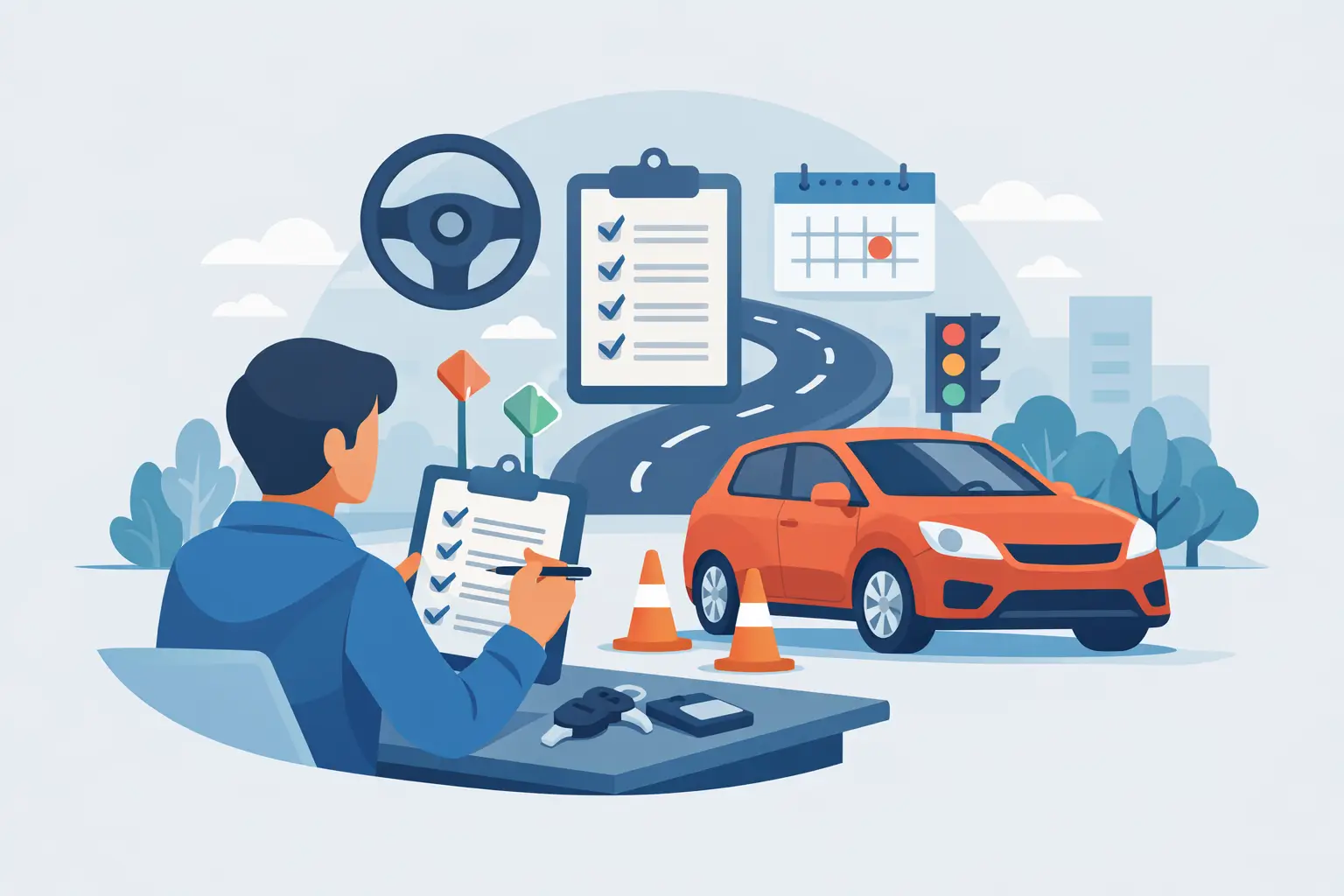
That last stretch before your test can feel odd. You can drive well in lessons, handle familiar roads and manage everyday situations, then suddenly start overthinking simple things because the practical driving test preparation stage makes everything feel more serious. That is completely normal. The key is not cramming or chasing perfection. It is getting yourself to a point where safe driving habits feel steady, familiar and repeatable.
A good test standard is really about consistency. Examiners are not looking for a performance. They want to see that you can drive safely, make sensible decisions and stay in control without needing help. When your preparation is structured properly, nerves become easier to manage because you know what is expected and you have practised it in the right way.
What practical driving test preparation should focus on
A lot of learners think the final stage is all about manoeuvres or memorising test routes. Those things matter, but they are only part of the picture. Strong practical driving test preparation is really about three areas working together – car control, decision-making and calmness under pressure.
Car control covers the basics that need to happen without too much mental effort. Moving off safely, stopping smoothly, choosing the right gear, maintaining a suitable speed and keeping good steering control all need to feel settled. If you are still fighting the car, it is much harder to spot hazards early or plan well.
Decision-making is where many faults appear. This includes reading road signs correctly, choosing safe gaps at junctions, dealing with roundabouts, reacting to other road users and showing awareness throughout the drive. It is not just about knowing the rules. It is about applying them in real time.
Then there is calmness. Even well-prepared learners can make mistakes when nerves creep in. A rushed approach to a roundabout, a missed mirror check or hesitation at a junction often comes from pressure rather than lack of ability. Preparation should reduce that pressure, not add to it.
Build test readiness, not just route familiarity
Driving around likely test roads can help, especially if your test is in Milton Keynes where roundabouts, changing speed limits and lane discipline can catch learners out. Still, route familiarity has limits. If you rely too much on knowing the roads, your confidence can dip the moment something unexpected happens.
A better approach is to practise the types of situations that regularly appear on test. Busy and mini roundabouts, dual carriageways, meeting traffic, hill starts, parked cars, independent driving and pulling up safely in different places all matter because they test your judgement. Once those skills are secure, unfamiliar roads become less of a problem.
This is one reason one-to-one tuition can make such a difference. You get time to focus on the areas that actually need work instead of repeating things you can already do comfortably. For some learners that means tightening up observations. For others it means making smoother progress or becoming more confident with manual gear changes under pressure.
The faults that are most worth fixing
Not every mistake has the same impact. Some are untidy but minor. Others suggest that your awareness or control is not quite there yet. In the final weeks before your test, it helps to be honest about what keeps coming up.
Observation faults are common, particularly at junctions, when moving off and during manoeuvres. Learners sometimes know they should check mirrors and blind spots, but do it too quickly or too late. The answer is not to exaggerate every movement. It is to make checks timely, purposeful and linked to what is happening around you.
Speed is another area where people lose marks. Driving too fast is obviously a problem, but driving too slowly can also create issues if it holds up traffic unnecessarily or shows uncertainty. Examiners want to see that you can make normal progress when it is safe to do so.
Positioning matters as well. Approaching roundabouts in the wrong lane, drifting within the lane, or giving parked cars too much or too little room can all suggest a lack of planning. These are usually fixable once a learner starts looking further ahead and thinking earlier.
If one issue appears repeatedly, do not ignore it because everything else feels fine. Repeated minor faults in the same area often point to a habit that needs proper attention before test day.
Why mock tests help – and when they do not
Mock tests can be useful because they show what happens when support is reduced and the pressure goes up a bit. That can reveal habits that do not show up in a normal lesson. You might drive well for forty minutes, then lose focus near the end. Or you might become hesitant when no prompts are given.
That said, mock tests are only useful if the feedback is clear and constructive. A poor result in a mock is not a reason to panic. It is simply information. The real value comes afterwards, when you break down where faults happened and why.
For some learners, several full mock tests are helpful. Others benefit more from targeted practice with short test-style sections. It depends on how you respond to pressure. If full mocks knock your confidence badly, it may be better to build up gradually.
Getting the manual car side right
In a manual car, test nerves often show up through clutch control and gear choice. A learner who is usually steady can start rushing the bite, selecting the wrong gear or coasting because they are trying too hard to keep everything smooth.
The answer is not to overcomplicate things. Keep returning to the basics. Slow the car down in good time, finish your braking before the turn if possible, choose a gear that matches your speed, and bring the clutch up with control. On hill starts, prepare properly rather than hoping the car will sort itself out.
If stalls happen occasionally in lessons, that does not automatically mean you are not test ready. What matters is how you deal with it. Staying calm, securing the car and restarting safely is far better than panicking.
The week before the test
The final week should be about sharpening, not squeezing in endless hours. If you are mentally tired, your driving often becomes less consistent. A well-planned lesson or two is usually more useful than trying to do too much.
Use that time to revisit the areas that still feel slightly awkward. That might be bay parking, pulling up on the right and reversing, or reading lane signs on larger roundabouts. You also want a realistic run through of independent driving, because following road signs or a sat nav can throw learners who are otherwise capable.
It is also worth getting the non-driving details sorted. Make sure you know the time of your test, have your provisional licence ready and understand where you are being picked up if your instructor is taking you. Little admin problems can raise stress before you even start the engine.
On the day, aim for steady not perfect
One of the biggest misunderstandings about the practical test is that a small mistake means you have failed. That is not how it works. Many good drives include minor faults. What matters is whether the overall drive is safe.
Give yourself time before the test. Rushing out of the house, skipping food or arriving flustered can put you on edge. If possible, have a short lesson beforehand so you can settle into the car and get your concentration where it needs to be.
During the test, keep your focus narrow. Do not spend the next five minutes worrying about one roundabout approach or a slightly awkward gear change. Deal with each moment as it comes. Often, the fault you think was disastrous was only minor, and sometimes it was not a fault at all.
If you are asked to pull up, move off, follow signs or carry out a manoeuvre, treat it like something you have done many times before. Because you have. The test environment is different, but the driving itself is not.
Confidence comes from good preparation
Real confidence is not telling yourself you will definitely pass. It is knowing that you have put the work in, fixed the weak points and practised until safe decisions feel natural. That is what makes learners more settled on the day.
At Pav’s Driving School, that preparation is strongest when it stays personal. Some learners need patient repetition. Others need a final polish and a bit more belief in their own ability. Either way, the goal is the same – to help you become a safe, capable driver, not just someone who gets through forty minutes of a test.
If your practical test is coming up, keep it simple. Focus on the habits that matter, practise with purpose and let your progress speak for itself. A calm, well-prepared drive usually looks much better than one that tries too hard.