When people search for “how many driving lessons needed”, they usually want one thing: a realistic idea of when they can book their practical test. The honest answer is that there is no fixed number. Learning to drive is not a race, and the right number of lessons is the number that helps you become a safe, confident and independent driver – not simply someone who can get through a test route.
For many learners, the journey takes months rather than weeks. Your starting point, how regularly you practise and how comfortable you feel on the road all make a genuine difference. A calm, structured plan with a qualified instructor will give you a clearer answer than comparing yourself with a friend who passed quickly.
How many driving lessons are needed on average?
A commonly quoted UK guide is around 45 hours of professional driving tuition, alongside roughly 20 to 25 hours of private practice. This is a useful benchmark, but it is not a rule. Some learners are ready in fewer hours, while others need more time to build safe habits and confidence.
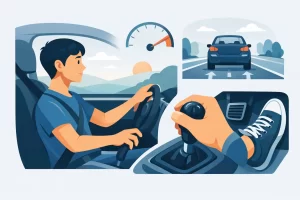
The figure includes far more than learning to move off and change gear. You need to develop observation, judgement, planning and the ability to deal with changing road conditions. For manual learners, this also means being comfortable with clutch control, gear selection and hill starts without letting the mechanics distract from what is happening around you.
Passing after fewer lessons can be possible when someone has regular, useful private practice and learns quickly. Taking extra lessons is equally normal, especially if you have limited practice opportunities, feel anxious in traffic or have not driven for a while. Needing more time is not a sign that you cannot pass. It often means you are giving yourself time to learn properly.
What affects how quickly you learn to drive?
Your first few lessons will reveal more than any online estimate. An instructor can see how you respond to instructions, whether you retain skills between lessons and which areas need more repetition.
Your previous experience
A complete beginner will usually need more tuition than someone who has already had some supervised practice. Even then, previous experience is only helpful if it has built good habits. If you have learnt to steer, brake or use the gears in an unhelpful way, a little time spent correcting those habits can prevent bigger problems later.
How often you have lessons
Weekly lessons suit many people because they allow time to absorb what they have learnt without losing momentum. If there is a long gap between lessons, you may spend part of the next session refreshing skills rather than moving forward.
More frequent lessons can speed up progress, but only if you have enough time to process each session. Two or three lessons close together are not automatically better if you leave each one tired, overwhelmed or unable to remember the key points. The best schedule is one you can maintain consistently.
Private practice between lessons
Practising with a suitable accompanying driver can be valuable. It gives you more time with the controls, more experience of everyday journeys and a chance to reinforce the topics covered in lessons. However, private practice works best when it supports professional instruction rather than replaces it.
Use it to practise familiar skills at an appropriate level. Repeatedly driving difficult routes before you are ready can damage confidence, while receiving conflicting advice can make learning feel harder. Your instructor can help you decide what is sensible to practise next.
The roads you learn on
Milton Keynes gives learners plenty of useful experience, from busy roundabouts and dual carriageways to quieter residential roads and rural routes nearby. Roundabouts are a major part of local driving, so learners need time to develop a clear routine for approach speed, lane choice, observations and safe exits.
That variety is positive, but it means progress should not be measured only by how quickly you can drive on quiet streets. Being ready for your test involves showing the same control and judgement when traffic is heavier, directions change and other road users make unexpected decisions.
Confidence, concentration and nerves
Some people grasp the physical skills quickly but need longer to feel settled around other traffic. Others are naturally calm but take extra time with clutch control or manoeuvres. Both are normal.
Good lessons should challenge you at the right pace. You should leave with clear feedback on what went well, what to work on and how to improve next time. A relaxed atmosphere matters, but so does honest guidance. Confidence grows from repeated safe decisions, not from being told you are ready before you feel it.
What should you be able to do before booking your test?
The practical test is not the point to try out skills for the first time. Before booking, you should be able to drive independently for a sustained period while dealing safely with the situations you meet.
This means moving off and stopping under control, using mirrors properly, choosing suitable road position and speed, and responding to signs, markings and other road users. You will also need to handle junctions, roundabouts, meeting traffic, pedestrian crossings and different road types. In a manual car, gear changes and clutch control should feel reliable enough that you can keep your attention on the road.
You should also be prepared for the independent driving section, one manoeuvre and the possibility of an emergency stop. More importantly, you should be able to recover safely from a small mistake. Every driver occasionally takes a less-than-perfect gear or needs to pause and reassess. Safe correction and good judgement matter far more than trying to drive flawlessly.
Do intensive driving lessons mean fewer hours?
An intensive course can suit a learner who already has a solid foundation, has a clear period of availability and can concentrate well over several days. It may reduce the calendar time between starting and taking a test, but it does not remove the need to gain real skill and experience.
For a nervous beginner, spreading lessons out can be more comfortable and more productive. It allows new skills to settle and gives you time for private practice. There is a trade-off: an intensive approach can feel focused, while regular lessons often make progress easier to manage around work, college or family commitments.
The most useful question is not “How fast can I pass?” but “What lesson pattern will help me drive safely and confidently on my own?”
How to get the most from each driving lesson
Arrive ready to focus and let your instructor know if something from the previous session did not make sense. Asking questions is part of learning, whether you are unsure about a roundabout, hill start or a manoeuvre.
After each lesson, make a quick note of the main points you covered and any targets for next time. If you practise privately, keep it focused on those targets. Regular sleep, a little preparation for theory and realistic expectations also help more than learners often realise.
At Pav’s Driving School, one-to-one manual lessons are designed around your current ability, not a one-size-fits-all timetable. Full-hour sessions and clear feedback help you see your progress and understand what remains before test day.
A better way to plan your lessons
Rather than paying attention to a single magic number, set short milestones. Your first aim may be moving off, stopping and steering comfortably. Next, it could be managing quieter junctions, then busier roundabouts, manoeuvres and independent driving. Those steps make a large goal feel manageable and show genuine progress.
A qualified instructor can review your driving honestly as you approach test standard and advise when a practical test is sensible. Until then, each lesson is doing valuable work: helping you make safer choices, build resilience and prepare for the freedom of driving independently.