If you are asking what is DVSA test, you are usually very close to the stage where driving starts to feel real. Lessons are under way, your theory revision is building up, and sooner or later you need to understand who sets the standard and what you are actually being tested on.
The DVSA is the Driver and Vehicle Standards Agency. It is the government body that oversees driving tests in Great Britain, as well as wider standards for drivers, instructors and vehicle safety. So when people say “the DVSA test”, they are often talking about the official test process run by the DVSA – usually the theory test or the practical driving test.
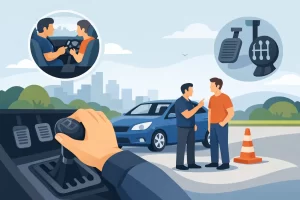
That sounds simple enough, but the phrase can be a bit misleading. There is not just one DVSA test. For learner drivers, it usually refers to two separate tests you need to pass before you can get a full licence: the theory test and the practical test. Knowing the difference helps you prepare properly and avoids the common mistake of focusing on one while underestimating the other.
What is DVSA test for learner drivers?
In everyday conversation, what is DVSA test really means, “What are the official tests I need to pass to become a qualified driver?” For most car learners, the answer is the DVSA theory test followed by the DVSA practical driving test.
The theory test checks whether you understand the rules of the road, can recognise hazards and know how to make safe decisions. The practical test checks whether you can apply that knowledge behind the wheel in real traffic, with proper control, awareness and judgement.
Both matter. Some learners are stronger in the car than they are with revision. Others can pass mock theory questions easily but struggle when they have to deal with roundabouts, meeting traffic or busy junctions under pressure. Good preparation means treating both tests seriously.
The DVSA theory test explained
The theory test is normally the first DVSA test you will take. It has two parts: multiple-choice questions and hazard perception.
The multiple-choice section covers areas such as road signs, stopping distances, speed limits, rules for different road users and what to do in certain situations. It is not designed to catch you out with trick wording, but it does expect you to understand the Highway Code properly rather than guess.
The hazard perception part is different. You watch video clips and identify developing hazards. This tests how quickly you notice situations that might require you to slow down, change position or stop. It is less about memorising facts and more about spotting risk early.
Many learners find the theory test manageable once they revise consistently. The challenge is usually not the difficulty of the content itself but leaving revision too late. A few short study sessions each week often work better than trying to cram everything at the last minute.
What happens in the practical DVSA test?
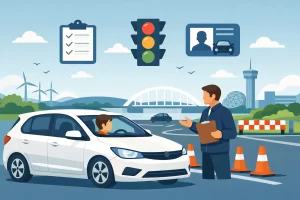
The practical test is the stage most learners mean when they ask what is DVSA test. This is the on-road assessment where an examiner checks whether you can drive safely and independently.
The test usually lasts around 40 minutes. During that time, you will drive on a variety of roads and deal with normal traffic conditions. You may be asked to carry out one manoeuvre, such as parallel parking, bay parking or pulling up on the right and reversing. You will also do a section of independent driving, where you follow sat nav directions or traffic signs.
At the start of the test, you will be asked one “tell me” vehicle safety question. During the drive, you will be asked one “show me” question. These are simple checks about basic vehicle knowledge, such as how to operate the demister or check that the brakes are working before setting off.
The examiner is not looking for perfect driving in the unrealistic sense. They are looking for safe, legal and competent driving. A small hesitation may not matter. Repeated poor judgement, missed observations or serious loss of control will.
How the DVSA marks the driving test
The practical test result is based on faults. These are usually grouped into three types: driving faults, serious faults and dangerous faults.
A driving fault is a minor mistake. You can still pass if you make a small number of these, as long as they do not build into a pattern that suggests weakness in an important area. A serious fault means your driving fell below the required standard in a way that could have been risky. A dangerous fault means there was actual danger to you, the examiner, the public or property.
This matters because learners sometimes worry about every tiny error. In reality, one imperfect gear change is not the issue. Consistent lack of observation at roundabouts, poor lane discipline or failing to respond to hazards is more serious. The test is about overall safety and decision-making, not whether you looked polished every second.
Why the DVSA test matters beyond simply passing
It is easy to see the test as just a barrier between you and your full licence. That is understandable, especially if you need to drive for work, study or family life. But the DVSA test matters because it sets a minimum safety standard for independent driving.
Passing should mean more than being “good enough on the day”. It should mean you can deal with real roads without your instructor stepping in. That includes busy Milton Keynes roundabouts, changing speed limits, residential roads with parked cars and the sort of decisions that come quickly when traffic is flowing.
This is why calm, structured lessons matter. Good instruction does not just rehearse test routes. It helps you understand why a situation is risky, how to plan early and how to stay composed when something changes unexpectedly.
Common misunderstandings about what is DVSA test
One common misunderstanding is that the test is there to make people fail. It is not. The examiner is there to assess whether your driving meets the standard, not to pressure you into mistakes.
Another is that the test only checks manoeuvres. Manoeuvres are a small part of it. The bigger picture is how you manage the full drive: mirrors, signals, speed choice, positioning, awareness, anticipation and response to other road users.
Some learners also assume that if they can drive well on familiar roads, they are test-ready. Sometimes that is true, but not always. Being ready means you can adapt, not just repeat what you know. If your confidence drops sharply when the route changes, more preparation may help.
When should you book a DVSA test?
There is no single right number of lessons because people learn at different speeds. Age, confidence, previous road experience and how often you practise all make a difference.
A sensible time to book your theory test is once you have started revising properly and can pass mock tests consistently. For the practical test, the best time is when your instructor believes you are close to test standard and you can drive safely without regular prompts.
Booking too early can add pressure and lead to disappointment if you are not ready. Booking too late can slow your momentum. It depends on your progress, your availability and how quickly local test dates are moving.
How to prepare in a calm, realistic way
The best preparation for any DVSA test is steady rather than dramatic. For theory, that means regular revision, learning the Highway Code and practising hazard perception properly. For practical, it means building strong routines and understanding what the examiner is looking for.
Mock tests can help, but only if they are used sensibly. They are useful for spotting weak areas and getting used to test conditions. They are less useful if they simply make you panic. The aim is confidence built on skill, not confidence built on hope.
It also helps to prepare for the feel of the day itself. That includes getting enough rest, arriving in good time and knowing that nerves are completely normal. Most learners feel them. What usually makes the difference is whether your driving habits are settled enough to hold up under pressure.
At Pav’s Driving School, this is why one-to-one manual lessons focus on calm progress and proper test preparation, not rushing learners from one stage to the next.
What is DVSA test really asking from you?
At its core, the DVSA test is asking one question: can you drive safely on your own? Not with reminders, not only on easy roads, and not only when everything goes to plan.
That can feel like a lot, but it is also fair. You do not need to be a perfect driver on day one of having a full licence. You do need to show that you can observe properly, make safe decisions and handle the car with control and care.
If you keep that in mind, the test often feels less mysterious. It is not a performance. It is a safety check based on skills you can build step by step. And that is a much better way to look at it when you are learning – not as a hurdle to fear, but as proof that you are ready to drive with confidence.