Your first few lessons can feel busy enough without worrying whether you have chosen the wrong type of car. You are learning road position, mirrors, roundabouts, junctions and traffic awareness at the same time. Choosing between manual or automatic lessons is therefore less about what other people are doing and more about what will help you become a safe, confident driver.
For many learners in Milton Keynes, Bletchley and Newport Pagnell, a manual licence remains the most flexible option. However, automatic tuition can be a sensible choice for some people, particularly if managing gears and clutch control is slowing their progress. The right answer depends on your driving goals, your confidence and the cars you expect to drive after passing.
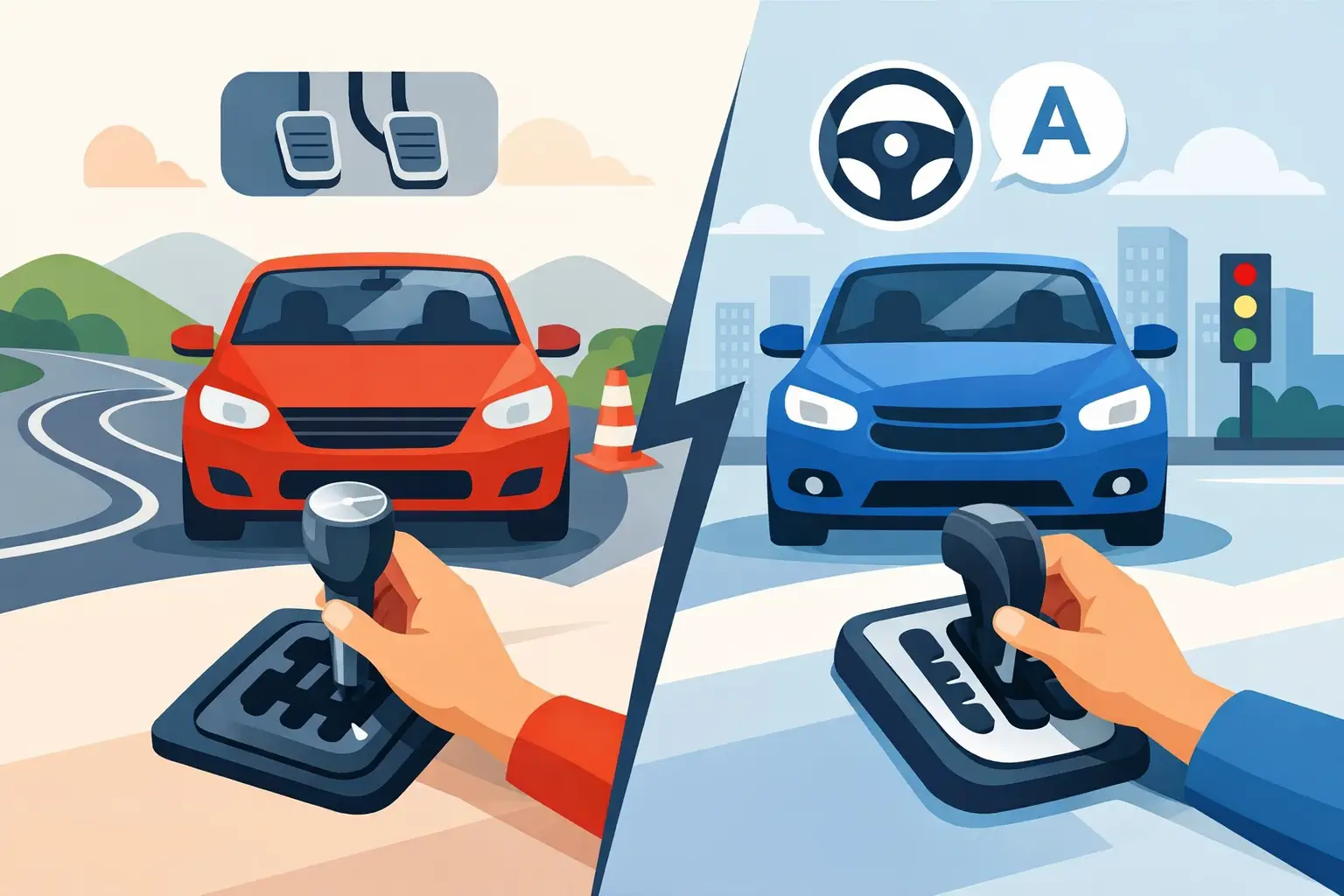
Manual or automatic lessons: the key difference
A manual car has a clutch pedal and gears that you select yourself. Learning to drive one means developing clutch control, changing gear smoothly and choosing an appropriate gear for the road and speed. It gives you more to do at first, especially when moving away uphill or approaching busy stop-start traffic.
An automatic car changes gear for you. With no clutch pedal to manage, you can often give more attention to steering, planning and reading the road. This can make the early stages feel simpler, although the same high standards of observation, judgement and control still apply.
The biggest practical difference comes after you pass your test. Passing in a manual car gives you a full licence, allowing you to drive both manual and automatic vehicles. Passing in an automatic car gives you an automatic-only licence, so you cannot drive a manual vehicle unless you later pass a manual practical test.
Why manual lessons remain a popular choice
Manual driving lessons ask more of you at the beginning, but many learners find that the extra effort pays off. Once clutch control and gear changes become natural, you have a wider choice of vehicles to drive, borrow or buy. This can be particularly useful if you share a car with family, are looking at lower-cost used cars or may need to drive different vehicles for work in the future.
A manual licence also avoids placing a restriction on your options. Even if you intend to drive an automatic after passing, being qualified to drive either type of car can provide reassurance. Circumstances change: a new job, a family car or a move can all affect the vehicle you need.
Manual lessons are not about making driving harder for the sake of it. They are about building coordinated control at a pace that works for you. With calm, one-to-one instruction, learners can practise moving off, changing gear and handling hill starts until those actions feel manageable rather than stressful.
At Pav’s Driving School, lessons are delivered in a manual car with a fully qualified, Government Approved Driving Instructor. That means each full-hour session can focus on the areas you need most, whether that is clutch control at the start or practical test preparation later on.
When automatic lessons may suit you better
Automatic lessons can be a good route if you are finding the physical coordination of a clutch and gears overwhelming. Removing that part of the task may help you settle more quickly and focus on road awareness, positioning and decision-making. For a nervous learner, this can make lessons feel less pressured.
They can also suit drivers who know they will only use an automatic vehicle. As electric vehicles become more common, this is a realistic plan for some people. Most electric cars are automatic, and many households now choose automatic cars for everyday driving.
That said, an automatic licence should be a positive decision rather than a rushed response to a difficult early lesson. Nearly every learner finds some parts of manual driving awkward at first. Stalling, over-revving or releasing the clutch too quickly are normal stages of learning, not proof that you cannot drive a manual.
A patient instructor can help you decide whether you simply need more practice or whether automatic tuition genuinely better matches your needs. There is no prize for choosing the tougher route if it does not suit you, but there is value in considering the long-term freedom that a manual licence provides.
Will one type of lesson get you passed faster?
Sometimes automatic learners need fewer lessons because they do not have to learn clutch and gear control. But this is not guaranteed. The practical driving test still requires you to drive safely and independently, deal with hazards, follow directions, manoeuvre accurately and make good decisions in changing traffic conditions.
Your progress will depend far more on regular practice, lesson quality, confidence and how quickly you develop safe routines. A learner who has automatic lessons may still need time to improve judgement at complex roundabouts or busy dual carriageways. A manual learner who practises consistently may become comfortable with gears sooner than expected.
It is best not to choose solely on the assumption that one option will be cheaper. The total cost of learning is based on the number of lessons you need, not just the hourly price. Choosing the vehicle type you are comfortable learning in can help you make steady progress and avoid changing direction halfway through your training.
Think about the car you will drive after passing
Before booking lessons, consider the first year after your test. Will you be using a parent’s car, sharing with a partner, buying your own vehicle or needing to drive for work? If the likely car is manual, manual lessons are the straightforward choice. If you know you will only have access to an automatic, automatic tuition may be entirely suitable.
It is also worth thinking beyond the immediate plan. A manual car can still be easier to find within certain budgets, and some employers may expect a full manual licence for roles involving driving. On the other hand, if your future driving is likely to be limited to an automatic or electric car, an automatic licence may meet your needs well.
There is no single answer for every learner. The best route is the one that supports safe driving now while giving you the options you are likely to value later.
How to make the decision with confidence
If you are unsure, start by being honest about what concerns you. Are you worried that manual driving will be too difficult, or do you simply feel anxious because you have never driven before? Most beginner nerves improve once you understand the controls and have time to practise without pressure.
A manual lesson can give you a realistic feel for clutch and gears before you make a long-term decision. You do not need to be perfect straight away. A good instructor will explain each step clearly, keep the lesson structured and adapt the pace to your ability.
If you have already had manual lessons and are struggling, discuss it openly. It may be that a little more practice on quiet roads, a clearer explanation of biting point or extra work on moving off will make the difference. If automatic is ultimately the better fit, choosing it is not a failure. Safe, capable driving is the goal.
Focus on the driver you want to become
Your test is an important milestone, but it is only the beginning of your driving experience. Whether you choose manual or automatic, look for lessons that help you understand the road rather than simply memorise test routes. You should leave each session feeling clearer about what you have practised and what comes next.
A relaxed learning environment, regular lessons and straightforward feedback can make a real difference to confidence. Give yourself permission to learn at your own pace, ask questions and build skills properly. The best choice is the one that helps you feel calm, capable and ready to drive safely long after test day.